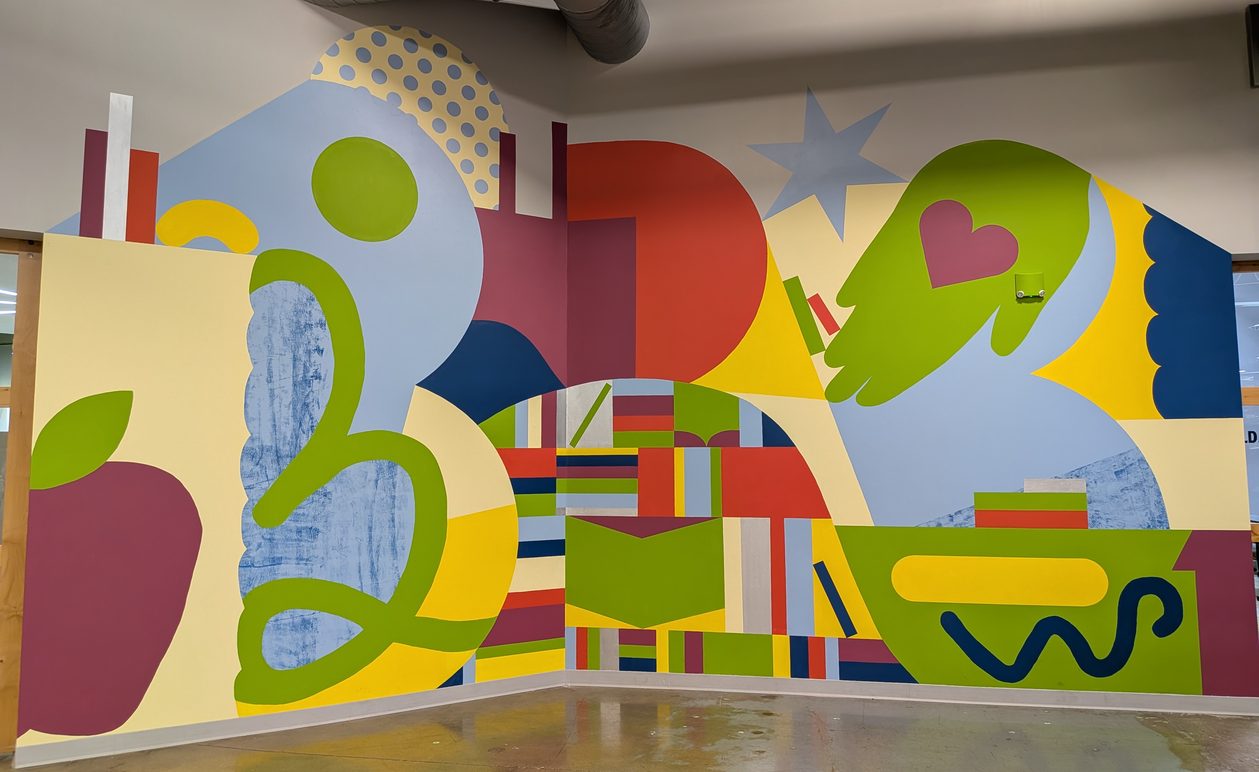
We are excited to officially unveil the newest addition to our Processing Center: a mural generously gifted by ConneXion and designed by artist Chad Kouri. The mural tells the story of Bernie’s Book Bank.
Look closely. Every shape tells the story of Bernie’s Book Bank. We believe better futures begin with books. Three B’s standing tall. Our script “b.” The green sticker, bag and helping hand of the volunteers and partners who power our work. Mountains of books — delivered free to the children who need them most. The Willis Tower. The Bean. Lake Michigan. And a #1, where it all began, in a garage in 2009. To bring this mural’s story to life even more, we sat down with Chad Kouri to learn more about the inspiration behind the design, the symbolism woven throughout the piece, and what it was like creating a visual representation of Bernie’s Book Bank’s mission.
1. As an artist, what first drew you to large-scale public art, and how would you describe your artistic style?
I really like the idea of bringing artwork out into the world we live in, instead of expecting us to seek it out. Large scale public art is accessible in a way that exhibitions or performances are not. You can just come upon them, which leaves a lot of space for curiosity and discovery. Having work out in the world creates an opportunity for emergence of memories and emotions and past experiences during the viewing process that work inside a museum or on a stage does not. That’s why I find it so powerful and exciting.
As for my “artistic style,” most of my work—visually, musical, and otherwise—starts as a collage of some sort. A mix for words or intentions. Various forms coming together for the first time. Field recordings emerging spontaneously during live performances. Colors from a photograph that happen to be together at the specific moment I passed them by. That, paired with attempting to find balance, whether that is with form or with color or with contrast. My goal is to find a good middleground between playful and sophisticated. Some might say my paintings are geometric abstraction. Some may say I’m a jazz musician. Some may say I’m a community organizer and culture worker. But at the most basic level, I’m a collage artist.
2. When you started designing this mural for Bernie’s Book Bank, how did you approach translating such a mission-driven story into visual art?
We focused a lot on the story and experiences people have when they are a part of that story. From there we focused on signifiers throughout the story that could be represented visually. Bernie’s garage, aspects of the volunteer experience like the circle sticker or the bag, landmarks in the region, and of course, lots and lots of books! But the approach was wide, and not always direct. It could be textures, like the dimples of a golf ball, it could be silhouettes of familiar shapes or objects. Or it could simply be two colors placed together in a specific way to represent a feeling or intention.
3. The mural is packed with meaningful symbols and hidden details. How do you balance creating something visually striking from afar while also rewarding people who take a closer look?
I’m happy you had this experience! That is exactly my intention. Playing with scale is a good way to make for a fun moment when a few feet away and in a different way at a distance. Also being very specific about color placement so all areas of the mural feel activated and alive. I approach it somewhat like a large painting with a bunch of smaller paintings inside of it. But instead of making the smaller ones and putting them all together, I make the big one first, and then fit little moments inside of it.
4. Many of the elements tie directly to Chicagoland and Bernie’s Book Bank’s history. Which part of the mural was the most meaningful or exciting for you to create personally?
I really appreciate the BBB mission and intention. As someone with dyslexia, I have a very specific and direct experience with books. Having a variety of books to choose from really helped me realize what I was interested in and showed me how to follow my curiosities. So making the work in general was a true gift. I’m also a big color nerd so I really enjoyed figuring out which colors felt best alongside the brand green. Bringing in the reflective metallic silver was a new challenge. I want people to search for aspects of themselves in my work like some strange magic mirror so having literal mirror-like areas helps push that intention a little more into the forefront.
5. Murals become part of a community’s everyday environment. What does it mean to you to create a permanent piece inside a place dedicated to helping children and families?
It is some of the most important work I could have the pleasure of doing. If my work has any part in making someone’s day a little brighter or softer or fun, I’ve done my job. And no better way to service the community than having an opportunity to make work that they live and grow with. Ideally all my work would live amongst some community or collective of people. This is why I prefer to sell my work to people who hang it and live with it instead of someone who puts it in storage and waits for the value to increase so they can sell it.
6. . There’s a strong balance between community, books, and Chicago culture throughout the mural. How did you approach blending those themes together into one cohesive piece?
When focusing on the Book Bank’s history, very clear paths presented themselves as far as what was important and what was implied. Person stories became the salt and pepper on top, where collective experience became the building blocks of the overall composition. For example, there is a stack of eight books on the right side of the mural that might not be recognizable to everyone who comes in, but everyone will recognize The Bean or Bernie’s B from his signature.
7. What kinds of conversations or reactions do you hope this mural sparks among volunteers, partners, and families walking through the space?
I really enjoy hearing people approach the artwork as some kind of hide and seek where you don’t know what you are looking for until you discover it. It’s also fun when people see pieces of themselves in the work. “Look! That looks like my mom’s house!” “Wow, that’s the exact same color as my couch at home!” “That squiggle looks so much like my cat!” I want people to have a conversation with the work, instead of just reading it and moving on.
8. If people want to see more of your work, where can they find other pieces of your art and how can they follow your work online?
The best place to find up to date info about me and my work right now is instagram. I also have a mailing list that I send out correspondence on 2-3 times a year or so. You can sign up here.
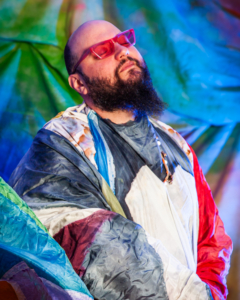
Photo credit: Marisa Klug-Morataya

